Lesson 13: The Third June Plan

Lesson 13/61 | Study Time: 30 Min
Lesson 13: The Third June Plan

On Feb. 20, 1947 the British Prime Minister clement Attlee made a statement in the British Parliament declaring that:


i. India shall be given independence by June 1948.


ii. If the Constituent Assembly fails to frame constitution within the stipulated time limit, the British government shall decide whether the powers are to be transferred to a central government or certain provincial governments.


iii. Mountbatten was appointed viceroy; he was to replace Wavell. 


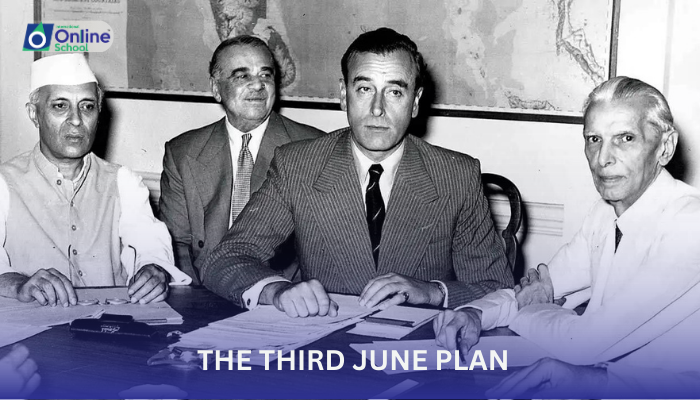
Mountbatten reached India in the last week of March 1947. He discussed matters with the Indian leaders and was convinced that it was not possible to keep India united for a longer period of time. Mountbatten worked out a partition plan and in May 1947 he flew to England to seek approval of the British Government on the plan. The approval was readily granted. On his return back he took seven important Indian leaders on June 2, 1947 including the Quaid-e-Azam in confidence. Given approval by all major Indian political parties the partition plan was announced by the Viceroy on June 3, 1947, following are the silent features of this Plan:


i. The British Government shall not impose its own constitution on India. The Indian Constituent Assembly shall frame a Constitution under which the government of the Indian Union shall be run. This Constitution, however, shall not be mandatory for the units unwilling to adopt it. These units shall be allowed to form constituent assemblies to frame constitutions of their own choice.


ii. The Provincial Assemblies shall be entitled to decide which of the two Constituent Assemblies their respective provinces shall join. The Plan stipulated different formulas for the provinces of the Punjab, Bengal the NWFP, Balochistan and for the district of Sylhet in East Bengal.


iii. The Princely States were also offered an option to join either of the two states, keeping in view their geographical position and "other conditions", or to remain independent by making treaty arrangements with either of the two successor states. 


iv. Powers were to be transferred by the British to one or two successor states, with "Demonian Status" during the same year.


Aamir Khan

Aamir Khan

Product Designer

Class Sessions

1- Lesson 01: Ideology 2- Lesson 02: Components of the Pakistan Ideology 3- Lesson 03: Pakistan: The Outcome of Sustained Muslim Efforts 4- Lesson 04: The Aligarh Movement 5- Lesson 05: Establishment of the All India Muslim League 6- Lesson 06: The Khilafat Movement: Events and Outcomes 7- Lesson 07: Khilafat Movement: Results and Consequences 8- Lesson 08: The Pakistan Resolution 9- Lesson 09: The Cripps Mission 10- Lesson 10: Election 1945-46 11- Lesson 11: The Cabinet Mission Plan 12- Lesson 12: The Simla Conference 13- Lesson 13: The Third June Plan 14- Lesson 14: Indian Independence Act 15- Lesson 01: Background of Initial Problems 16- Lesson 02: Problems of the New Born State of Pakistan 17- Lesson 03: Accession of the Princely States 18- Lesson 04: Efforts for Resolving the Problems 19- Lesson 05: National Solidarity and Stability 20- Lesson 01: Location 21- Lesson 02: Temperature Zones 22- Lesson 03: Imbalanced Economic Growth and Regional Disparities 23- Lesson 05: Tourist Attractions in Pakistan 24- Lesson 06: Map-Reading 25- Lesson 04: Pakistan's Geo-Strategic Position 26- Lesson 01: The Objectives Resolution 27- Lesson 02: Islamic Provisions of the 1956 Constitution 28- Lesson 03: Islamic Provisions of the 1962 Constitution 29- Lesson04: Islamic Provisions of the 1973 Constitution 30- Lesson 05: Steps towards Islamization (1949-1977) 31- Lesson 06: Steps towards Islamization (Since 1977) 32- Lesson 07: Rights and Responsibilities (Duties) 33- Lesson 08: Human Rights 34- Lesson 09: Fundamental Human Rights Adopted by the UN 35- Lesson 01: Administrative Structure of Pakistan 36- Lesson 02: Organs of the Federal Government and their Functions 37- Lesson 03: Provincial Governments: Their Powers and Functions 38- Lesson 04: Concept of Good Governance in Islam 39- Lesson 01: Culture of Pakistan 40- Lesson 02: Important Ancient Sites of Cultural Significance 41- Lesson 03: Important Buildings of the Muslim Period 42- Lesson 04: Common Characteristics of the Pakistani Culture 43- Lesson 05: Gender Equity: Issues and Problems 44- Lesson 06: Rights of Women in Islam 45- Lesson 07: Policies for Women Participation In Socio-Political Affairs of Pakistan 46- Lesson 01: Languages of Pakistan 47- Lesson 02: CHARACTERISTIC FEATURES OF URDU 48- Lesson 03: Regional Languages of Pakistan 49- Lesson 01: MEANING OF NATIONAL INTEGRATION 50- Lesson 02: Significance of National Integration in an Islamic Democratic State 51- Lesson 03: Problems of National Integration in Pakistan 52- Lesson 01: What is planning? 53- Lesson 02: Economic Planning in the Light of Five Year Plans 54- Lesson 03: Economic Planning in Pakistan: a Bird's Eye View 55- Lesson 01: WHAT IS FOREIGN POLICY? 56- Lesson 02: Factors Determining the Foreign Policy of Pakistan 57- Lesson 03: Pakistan's Foreign Relations with China 58- Lesson 04: Islamic Republic of Pakistan and India 59- Lesson 05: Islamic Republic of Pakistan and Iran 60- Lesson 06: Islamic Republic of Pakistan and Afghanistan 61- Lesson 07: Islamic Republic of Pakistan and Saudi Arabia